
Is Coconut Water Good for Weight Loss?An Honest Answer
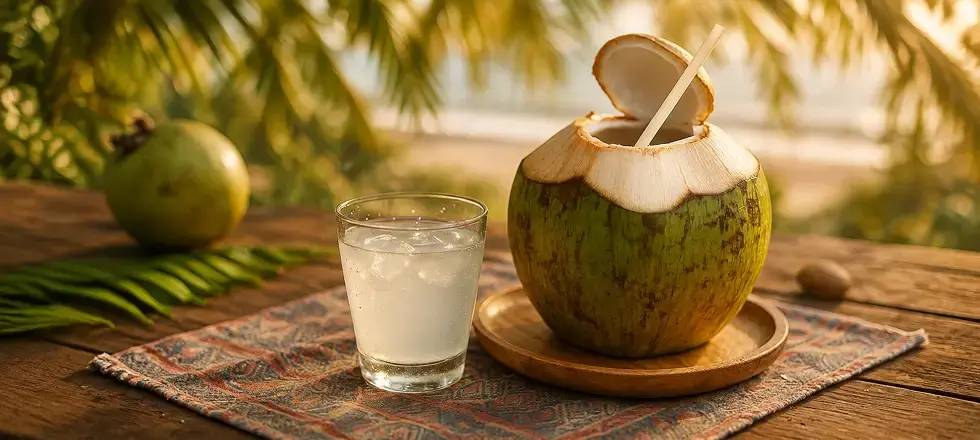
I get asked about coconut water more than almost any other food in this country, and the question always arrives with the same hopeful phrasing. "Sir, if I drink two coconut waters a day, will the belly fat go?"
The short answer is no. Coconut water does not burn fat, does not raise your metabolic rate, and does not detoxify anything. Your liver and kidneys handle that department and they do not need help from a beverage.
The longer answer is more interesting, because coconut water can still be genuinely useful during a fat loss phase. It just works through a mechanism nobody talks about. Let me explain properly.
What is actually in a tender coconut
A standard 240 ml glass of fresh tender coconut water contains roughly 45 to 60 calories, around 9 to 11 grams of naturally occurring sugar, close to 600 mg of potassium, about 250 mg of sodium, and useful amounts of magnesium and manganese. Fat is negligible. Protein is close to zero.
A single tender coconut from a roadside vendor usually gives between 200 and 400 ml depending on size, so one coconut lands somewhere between 40 and 100 calories.
That potassium number is the standout figure. A glass of coconut water carries more potassium than a medium banana, and most Indian diets are short on potassium while being heavy on sodium. That imbalance contributes to water retention and to blood pressure creeping upward over the years.
So why does it have a fat loss reputation?
Three reasons, and only one of them is legitimate.
The first is the substitution effect, and this is the real one. If your afternoon drink is currently a cola, a packaged fruit juice, a sweetened iced tea or a glass of sugarcane juice, switching to tender coconut water cuts a meaningful number of calories from your day. A 250 ml cola is around 100 calories of pure sugar. Sugarcane juice runs far higher, often 180 calories or more per glass, and street versions are frequently larger than a glass. Packaged orange juice sits around 110 calories with almost none of the fibre of the fruit.
Trade any of those for a tender coconut and you save between 50 and 150 calories per serving without feeling like you are depriving yourself. Do that daily for a few months and it shows up on the scale. That is not the coconut working magic. That is arithmetic.
The second reason is the deflation effect. Because coconut water improves potassium intake and helps you stay hydrated, some people carry less subcutaneous water within a week or two of drinking it regularly. The face looks less puffy, the waistband feels easier. This is water, not fat. It is a real and visible change, but it stops after the initial correction and it is not the same thing as losing body fat.
The third reason is marketing, particularly on the packaged side, and I have no patience for it. There is no credible human evidence that coconut water increases fat oxidation, accelerates metabolism or targets abdominal fat. Any product making that claim is selling you a story.
Where coconut water genuinely earns its place
I recommend it in specific situations rather than as a blanket instruction.
Around training. For sessions lasting under an hour in a cool gym, plain water is sufficient. But for outdoor running in Bengaluru or Mumbai humidity, for long cycling rides, for hot yoga or for anyone who finishes a workout with visible salt lines on their shirt, coconut water is a sensible natural rehydration option. It supplies potassium, some sodium and a small amount of easily available carbohydrate. I would still add a pinch of salt to it for sessions past ninety minutes, because coconut water is comparatively low in sodium relative to what heavy sweating removes.

When you are recovering from illness. During a bout of gastroenteritis or a viral fever with poor appetite, coconut water is gentle on the stomach and helps replace lost fluid and electrolytes. It does not replace a proper ORS for significant dehydration, and I want that stated clearly, but for mild cases it works well.
As a craving interceptor. The 4 pm slump is where most diets break. Something cold and slightly sweet at that hour, for 50 calories, prevents a 400 calorie decision twenty minutes later. That is a fair trade.
During pregnancy and in hot weather. It is a clean source of fluid and minerals, easy to tolerate, and preferable to most other flavoured options.
The mistakes I see
Adding it on top instead of instead of. People keep their existing diet exactly as it is, add three coconuts a day for health, and add 200 calories to their intake. Coconut water only helps if it replaces something. It has to displace, not accompany.
Eating all the malai. The soft flesh inside a tender coconut is a different food entirely from the water. Coconut meat carries fat, largely saturated, and roughly 350 calories per 100 grams for the mature version. A little is fine and it is satisfying. Scooping out the entire lining of two coconuts a day is not a weight loss strategy.
Assuming the carton equals the coconut. Many packaged coconut waters are made from concentrate, come from mature rather than tender coconuts, and carry added sugar or added fruit juice. Read the label. If the ingredient list is anything other than coconut water, and if the sugar figure per 100 ml is meaningfully above about 4 grams, you are drinking a soft drink with a wellness photograph on the front.
Believing it replaces plain water. It does not. Water remains the base of your hydration, at zero calories. Coconut water is a supplement to that, not a substitute for it.
How much, and when
For most healthy adults trying to lose fat, one tender coconut a day is a comfortable ceiling. Two is acceptable if you are training hard, sweating heavily or working outdoors, and if those calories are accounted for.
On timing, there is no magical hour. The idea that it must be consumed on an empty stomach at sunrise for the benefits to apply has no basis. Drink it when it displaces something worse or when you actually need the fluid, which for most people means mid morning, before or after training, or during the afternoon slump. I would avoid making it the last thing you drink before bed, purely to save yourself a trip to the bathroom at 2 am.
Who should be careful
This section matters more than the rest of the article.
Anyone with chronic kidney disease or reduced kidney function. Damaged kidneys cannot clear potassium efficiently, and high potassium in the blood is a serious problem affecting heart rhythm. Coconut water is potassium dense. If you have kidney disease, do not drink it without your nephrologist's clearance.

Anyone on potassium sparing diuretics, ACE inhibitors or ARBs, which are common blood pressure medications that raise potassium retention. Discuss it with your doctor.
People with diabetes. Coconut water is not sugar free. Ten grams of sugar in a glass is not catastrophic, but two or three coconuts a day is a genuine carbohydrate load. Keep it to one, and preferably alongside a meal containing protein and fibre rather than by itself.
Anyone told to restrict fluid or sodium for a cardiac or renal reason.
The verdict
Coconut water is a good drink. It is not a weight loss tool.
If it takes the place of sweetened beverages in your day, it will help you lose fat, in exactly the same way that walking instead of taking an auto helps you lose fat. The benefit lies in what you stopped doing, not in the coconut itself.
Fat loss still comes from the same four things it always came from. A calorie deficit you can sustain, enough protein to hold on to your muscle, resistance training two or three times a week, and sleep. Coconut water fits neatly inside that structure. It will never be a replacement for it.
Drink the coconut. Just do not expect it to do the work for you.


Comments