
Indian Breakfasts Under the Microscope : Which Ones Are Actually Good for Metabolic Health?
Every week, someone in my clinic asks me a version of the same question.
“Ryan, is idli healthy or not?”
“Is poha good for weight loss?”
“Should I stop eating dosa?”
And every time, my answer disappoints them a little, because I don’t give them a straight yes or no.
I ask them a different question instead. Which idli? Made how? Eaten with what? In what quantity?
Because that is the real problem with how we talk about Indian breakfasts. We treat them like one single category. As if idli is idli everywhere, dosa is dosa everywhere, poha is poha everywhere. It isn’t. And if we don’t start looking closer, we keep giving people advice that sounds like nutrition but is practically useless.
So let’s actually put our breakfasts under the microscope.
The same breakfast is not the same breakfast
Let’s start with dosa, because the data here genuinely surprised me the first time I saw it. A study measuring the glycemic index and glycemic load of 23 commonly eaten South Indian breakfast dishes found that onion dosa came in with a glycemic index close to 80, among the highest tested. Vada sambar came in around 37, one of the lowest. Plain dosa carried the highest glycemic load of the entire dataset, while vada sambar had the lowest.
Read that again. Both dishes fall under the same label of “South Indian breakfast.” One behaves in your bloodstream almost like drinking sugar water. The other doesn’t.
The same pattern shows up with idli. Some tested rice idli preparations have shown a glycemic index in the mid-80s. But formulations that swap part of the rice for millets have tested closer to 37. Same name on the menu, completely different metabolic behaviour, because the ratio of rice to dal or millet changed.
This is the first thing I want you to take away from this article. Stop asking whether a dish is good or bad. Start asking how this specific version is made, and how much of it is on your plate.
Why fermentation actually works in your favour?
Here is something about traditional Indian breakfast preparation that deserves more credit than it usually gets. Fermentation.
Idli and dosa batter is fermented before it is cooked, and that process produces organic acids which slow gastric emptying and blunt the glucose response compared with eating the same grains unfermented. Our grandmothers were practising food science long before food science had a name for it.
This doesn’t make fermented rice batter a low glycemic food. It still isn’t, especially in the quantities most of us eat it in. But it explains why idli and dosa, despite being rice-heavy, don’t spike blood sugar quite as sharply as plain white rice eaten the same way.
What the rice research actually tells us?
Rice sits at the centre of so many Indian breakfasts, so I want to bring in a study I refer to often with my clients. Dr V Mohan’s team at the Madras Diabetes Research Foundation ran a randomised controlled trial comparing white rice, brown rice, and brown rice combined with legumes in overweight Asian Indian adults. The brown rice with legumes combination produced meaningfully better glucose and insulin responses than white rice alone.
More recently, the same research group used continuous glucose monitoring to compare a high fibre rice variety against regular white rice in Asian Indians over a full 24 hour period. The higher fibre rice produced a flatter, more favourable glucose profile. This reinforces something I keep repeating to my clients. It isn’t rice itself that is the problem. It is refined, fibre-stripped rice, eaten alone without protein or fibre alongside it, that causes the trouble.
Poha deserves an honest conversation
Poha gets treated like the safe, light breakfast in most Indian households. I want to be honest about where that reputation is only partly earned.
Flattened rice sits in the medium to high glycemic index range, and eaten plain, without any protein added, its glycemic load can end up higher than people expect from something that looks so light on the plate. That doesn’t mean you need to give up your poha. It means the poha you eat with just peanuts and a squeeze of lime behaves very differently from the poha eaten alongside a boiled egg or a bowl of curd.
The breakfasts that consistently perform well
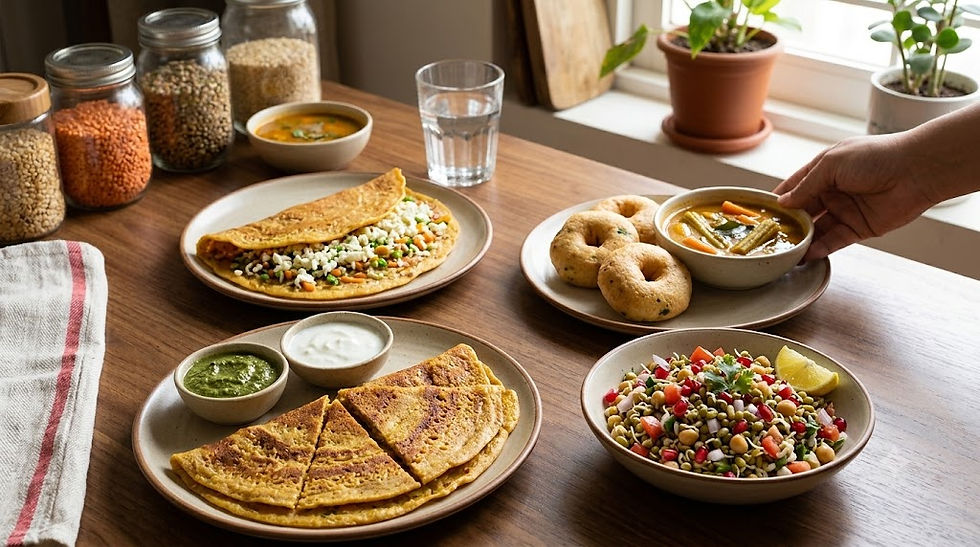
If I had to point to the categories that show up favourably again and again in the research, here is what they have in common. They are legume-forward, and they carry protein built into the dish itself, not added as an afterthought.
Moong dal chilla or moong dosa. whole green moong has one of the lowest glycemic index values in the Indian kitchen and a chilla made from it typically delivers around 12 to 14 grams of protein a serving.
Besan chilla. gram flour is naturally high in plant protein and fibre and a besan crepe stuffed with vegetables or paneer can bring in 15 to 18 grams of protein.
Sprouts, as a chaat or a light stir fry and slow to digest, genuinely filling, minimally processed.
Vada sambar, when it isn’t deep fried in excess oil the lentil base is doing real metabolic work which is exactly why it tested lowest on both glycemic index and glycemic load in the South Indian dataset I mentioned earlier.
Notice the common thread. Protein and fibre arrive with the carbohydrate, not after it.
Why does the sequence of eating matter as much as the dish?
There is a small but consistently replicated finding I think more people should know about. Eating protein or vegetables before your carbohydrate, even within the same meal, blunts the glucose spike that follows. Some diabetologists now advise starting your plate with a non-starchy vegetable, or even a spoon of curd or an egg, before you touch the idli or the dosa.
I am not asking you to overthink your breakfast to this level of precision every single day. But if you are actively managing insulin resistance, prediabetes or a stubborn waistline, this sequencing costs you nothing and genuinely helps.
So what should you actually do
Here is what I want you to walk away with, because vague advice has never helped anyone change their breakfast.
Stop asking whether a dish is good or bad. Ask what it’s made of and how much of it is on your plate.
Choose the legume forward version of your usual breakfast where you can. Moong dal chilla over plain poha. Vada sambar over onion dosa. Idli with sambar over idli with only chutney.
Add a protein source to whatever you already eat. An egg, a bowl of curd or a handful of roasted chana alongside your poha or upma changes its metabolic impact meaningfully.
Watch your portion, not just your food choice. Two idli with sambar and a boiled egg is a very different breakfast from six idli with only chutney.
Where you can, eat your vegetables or your protein first, and your rice or wheat-based portion after.
None of this requires giving up the breakfasts you grew up eating. It requires being a little more deliberate about how they’re made and what they’re eaten with.
If you want to know exactly which version of your everyday breakfast fits your own metabolic profile, that is the kind of personalized assessment my team at Qua Nutrition Signature Clinic does for our clients. Fill out the form, and let’s actually look at your plate, not just guess at it.


Comments